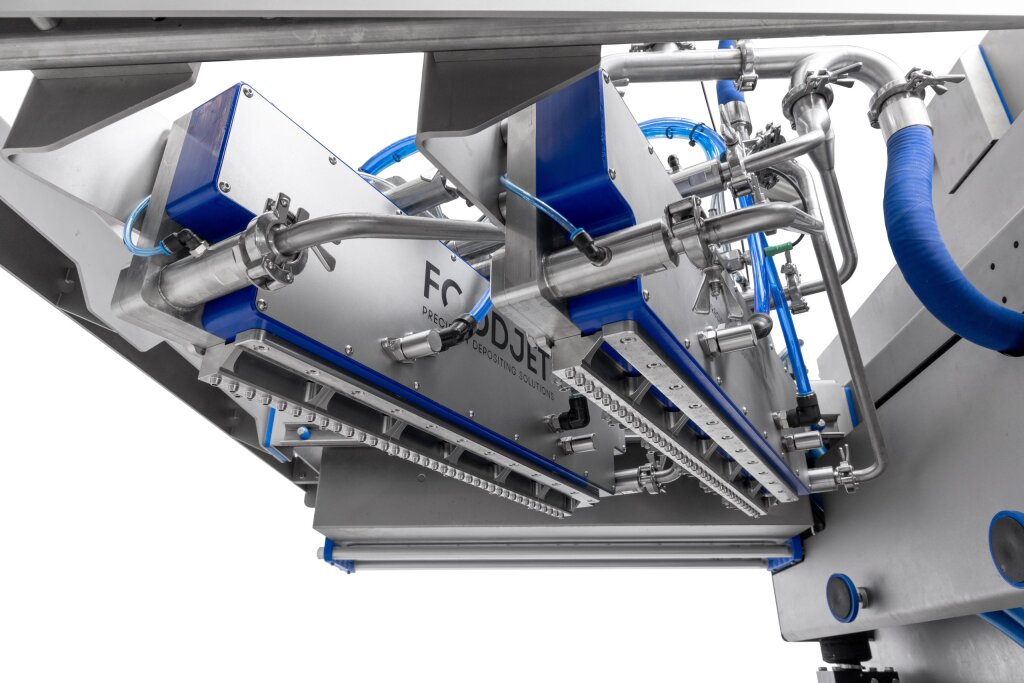
FoodJet
FoodJet depositor above a production line, depositing sauce onto pizza bases on a blue conveyor belt

Vision-guided depositing

How a camera lets the deposit follow the product, even when products are not aligned, vary in shape, or rotate on the belt.

What is vision-guided depositing?
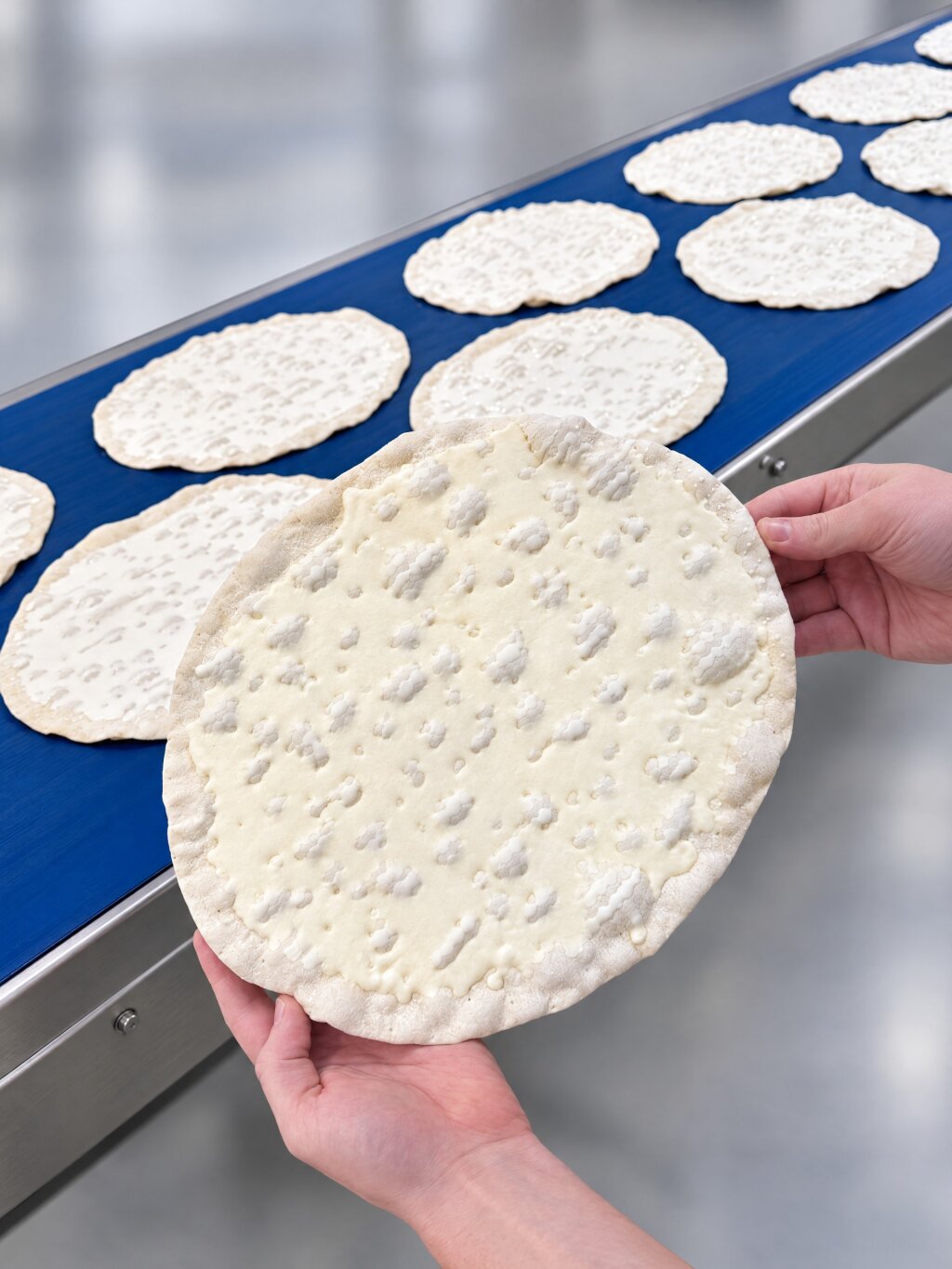
Pizza bases with a thin layer of white sauce on a blue belt, one base held up in two hands

Vision-guided depositing uses a camera and software to detect each product's position, shape and orientation on the conveyor in real time. The depositor then adapts the deposit pattern per product, so sauce, cream or other toppings land accurately even when products are not perfectly aligned, vary in shape, or rotate on the belt. The deposit follows the product, not the other way around. This reduces rejects, keeps the conveyor cleaner, and supports product variation without complex mechanical tooling.
What a vision system detects

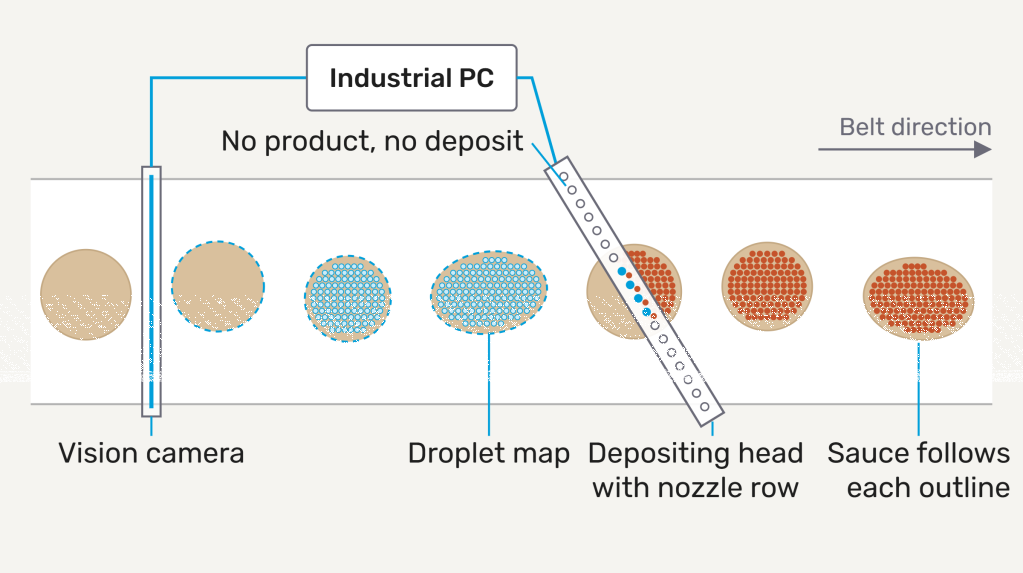
Diagram of on-demand depositing: vision, droplet map and an angled depositing head that deposits only on products

A vision system detects and tracks key features per product in real time:

  • Position (X/Y): where each product sits on the belt, so the depositor compensates for small shifts.
  • Shape and contour: the outline of the product, so the deposit pattern adapts to variable sizes or irregular shapes.
  • Orientation and rotation: whether a product is rotated, so the deposit stays aligned with the product rather than the conveyor.

The result is a real-time output of coordinates and an OK or NOK status per product, which the line control can use to adjust the deposit pattern, inhibit depositing, or trigger a reject.

How vision improves accuracy

On real production lines, products rarely stay perfectly aligned. Small shifts, belt vibration or manual loading cause inconsistent placement and rejects. Vision detects the product position and compensates in real time, so deposits land on the product, not next to it. In practice this helps you reduce rejects from misplacement, lower manual rework and cleaning, and improve process stability for downstream sealing and packaging.

In-line quality control before depositing

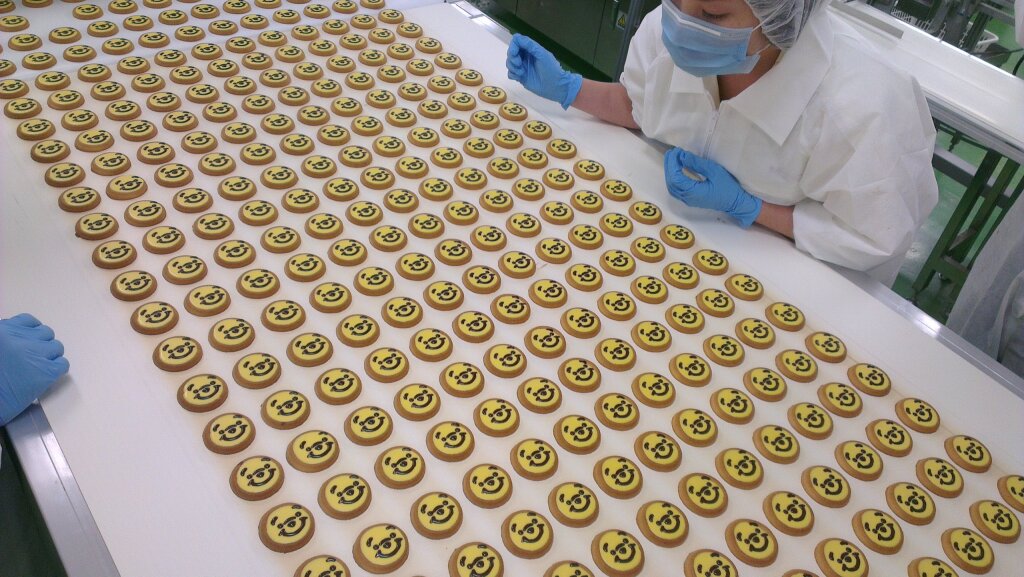
Rows of biscuits with smiley decorations on a conveyor, checked by an operator

Vision can also run quality checks before the deposit, such as detecting a missing product, a product out of position beyond tolerance, or a deformed or damaged shape. Based on these checks the system can inhibit depositing or send a reject signal, so you avoid wasting product and reduce downstream issues. For example, if a biscuit is broken, the depositor skips that position and triggers a reject for that product. This is the principle of no product, no deposit: material only lands where there is a good product to receive it.

When sensors are enough, and when you need vision

A simple sensor can be enough when products have a consistent shape, alignment and spacing, and you only need on or off presence detection. Vision is the better choice when products vary in shape or placement, rotate or appear in multiple orientations, or when you want quality checks and data per product.

  • Chocolate decoration on misaligned Jaffa cakes

    Chocolate decoration on misaligned Jaffa cakes

    Chocolate decoration depositing on randomly aligned Jaffa cakes and biscuits. More info here

How FoodJet uses vision

Underside of a FoodJet depositing unit

FoodJet's depositing technology is built to make the most of vision. The array of individually controlled nozzles in each depositing head can follow products wherever they sit on the conveyor, so the deposit pattern adapts to position, shape and orientation per product. This is what lets one line handle products that vary, without fixed tooling. See on-demand depositing with a nozzle array for how the head works.

How we prove it for your product

Reliable vision depends on a stable setup as much as the camera: consistent lighting, enough contrast between product and background, predictable product presentation, stable conveyor motion, and a hygienic installation that fits your cleaning regime. To assess your line we usually look at a top-view photo or short video of the conveyor, your line speed and product spacing, the product type and surface, and the deposit pattern and tolerances you need. We then run a trial with your actual product, so you see the result before you commit.

FAQ

What is vision-guided depositing?

Vision-guided depositing uses a camera and software to detect each product's position, shape and orientation on the conveyor in real time. The depositor adapts the deposit pattern per product, so toppings land accurately even when products are not aligned or vary in shape.

What can a vision system detect on a conveyor?

It detects position (where each product sits), shape and contour (the outline), and orientation or rotation. It outputs coordinates and an OK or NOK status per product, which the line control uses to adjust, inhibit or reject.

What does no product, no deposit mean for vision?

Vision checks whether a good product is present and in position before depositing. If a product is missing, out of position or damaged, the depositor skips that position and can trigger a reject, so material is not wasted.

When do I need vision instead of a sensor?

A sensor is enough when products have consistent shape, alignment and spacing and you only need presence detection. Vision is needed when products vary in shape or placement, rotate, or when you want quality checks and data per product.

What do you need to assess vision for my line?

Typically a top-view photo or short video of the conveyor, your line speed and product spacing, the product type and surface, and the deposit pattern and tolerances. We confirm feasibility in a trial with your own product.

Every FoodJet system is configured and quoted to fit your line and your requirements.