FoodJet

Food depositing line capacity

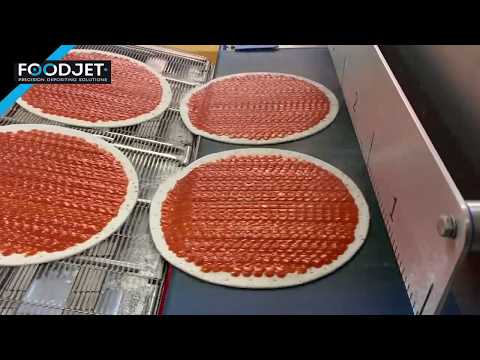
Surface filling is the technique of covering the entire surface of a product with an even layer of a liquid food such as sauce, butter or batter, while keeping a defined sauce-free edge. Vision technology recognises the shape of every product on the conveyor, so the material lands on the product and not around it, even on irregular or randomly placed products. When you change product shapes you upload the matching recipe and keep running, with no mechanical change-overs.

What is food depositing line capacity?
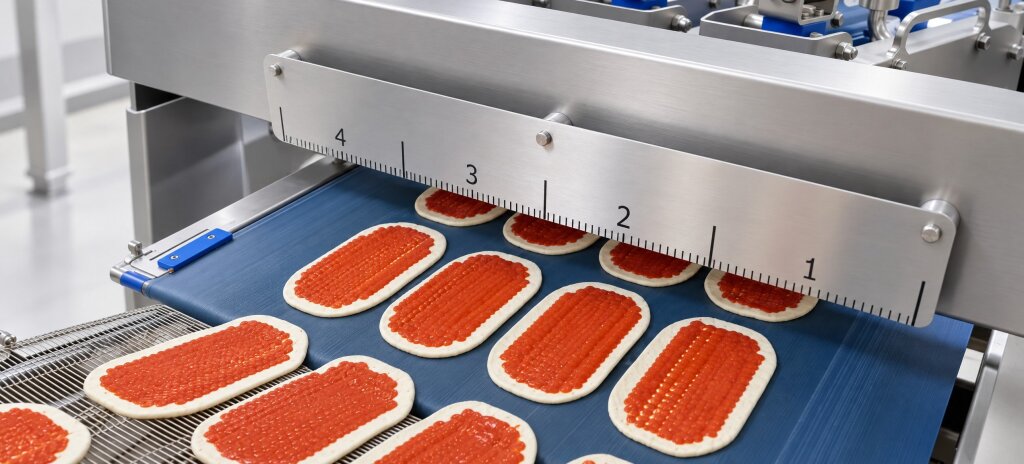
Your food depositing line capacity is how many products you can deposit on per minute, and it comes down to four numbers: the size of your product, the pitch between products, the number of lanes, and the belt speed. The first three set how densely products sit on the belt; the belt speed sets how fast they pass. The one factor that needs our input is whether we can deposit your product accurately at that speed, because that depends on the material.
Working out your capacity

You can get a solid estimate of your line capacity yourself, with four numbers.

  • Product size: how large is a single product?
  • Pitch: how much space sits between products, both across and along the belt?
  • Number of lanes: how many products run side by side?
  • Belt speed: how fast the belt moves, in metres per minute (m/min)?

Product size, pitch and lanes together decide how many products fit on the belt at any moment. Multiply that by the belt speed and you have your capacity in products per minute, and from there per hour or per shift. This part is straight maths, and you do not need us for it.

What the belt speed depends on

There is one factor that does need our input: can we deposit your product accurately at the belt speed you are aiming for? That depends entirely on the material. Viscosity, temperature, particle size and the way a product flows all affect how fast we can dose it cleanly. Two products that look alike can run very differently on the same machine, so treat any figure as a guide for a first estimate, not as a limit.

More products on the same belt

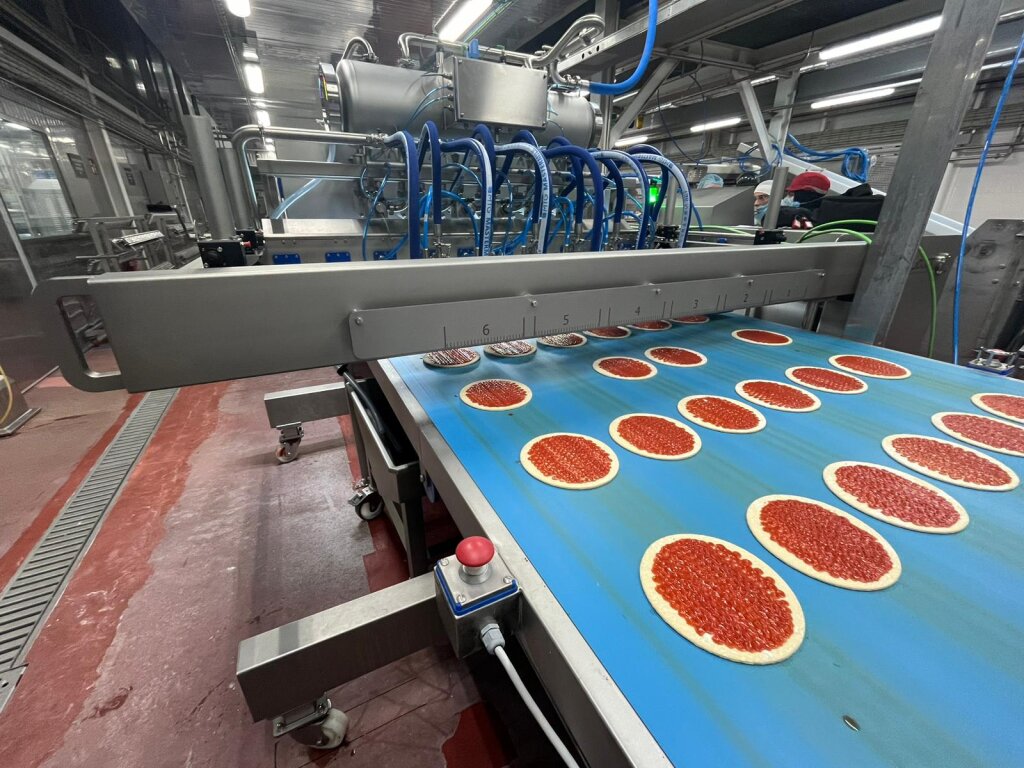
The core of a FoodJet system is the depositing head: an array of individually controlled nozzles across the full width of the belt. Each nozzle deposits on demand, so the head places material on any product, anywhere across the belt, in any pattern, with no fixed tooling and no set product positions. Vision recognises where every product sits, and the nozzle array deposits exactly there. Together this means you do not lose belt space to alignment or to a fixed pitch: you run products closer together and across the full width, so the same belt and the same speed deliver more products per minute. The smaller the product, the more this counts.

A worked example

On a standard 800 mm belt this is clearest with small products. Take mini pizzas of around 100 mm. Because the nozzle array deposits on each one wherever it sits, you can run them close together across the full width and along the belt, instead of in a few fixed lanes. At 25 m/min that runs to roughly 1,600 mini pizzas per minute, around 95,000 per hour. Full-size 300 mm pizzas on the same 800 mm belt at the same speed run to roughly 160 per minute. The depositing head does not change; the belt simply carries far more product.

Capacity in practice

Sauce on pizzas

Even base layers and repeatable patterns for consistent coverage and portion control.

Garlic butter depositing

Tiger paste depositing

Proven line speeds by material

Line speed depends on the material, so use these as a guide for a first estimate, not as a limit. For every application we confirm the figure in a trial.

Material

Proven line speed (guide)

Pizza sauce and similar

up to 25 m/min

Cream (per lane)

around 15 m/min

Butter or cream on bread

around 10 m/min

Hot products (chocolate, marmalade)

around 10 m/min

Whether we reach these speeds, or higher, for your product depends on how it behaves on the line.

Work out your line with us

We do not stop at the calculation. For every application we run a trial with your actual product, so the capacity you plan with is one we have measured, not one we have assumed. Share your product, your belt width and your target output, and we will help you work through the numbers and confirm the line speed in a trial.

How much capacity can a FoodJet line handle?

In most cases you can work this out yourself. Your output comes down to four numbers: product size, pitch, number of lanes and belt speed. The first three tell you how densely the products sit on the belt; multiply that by the belt speed and you have your output per minute. The one factor we confirm is whether we can deposit your product accurately at that speed, because that depends on the material. As a guide, line speeds up to 25 m/min have proven possible for pizza sauce and similar products. To be sure, we run a trial with your own product.

What determines the belt speed you can run?

The material. Viscosity, temperature, particle size and the way a product flows all affect how fast we can dose it cleanly. Two products that look alike can run very differently, so we confirm the speed in a trial.

Do more, smaller products lower my capacity?

The opposite. Because the nozzle array deposits on each product wherever it sits, you run small products close together across the full width instead of in a few fixed lanes, so the same belt and speed deliver more products per minute. The smaller the product, the more this counts.

Do you guarantee the capacity figure?

We give you a figure measured on your own product. The calculation is straight maths you can do yourself; the part we confirm is the belt speed for your material, which we measure in a trial so you plan with a real number.

Increase accuracy, improve speed and add a unique touch