FoodJet

On-demand depositing with a nozzle array

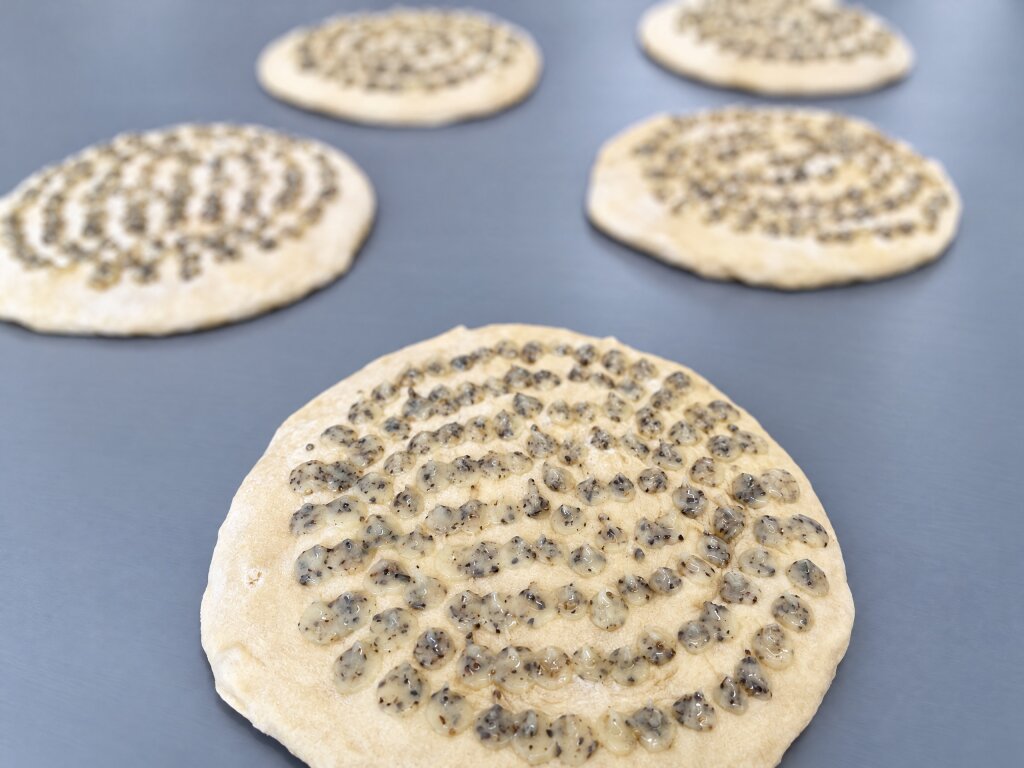
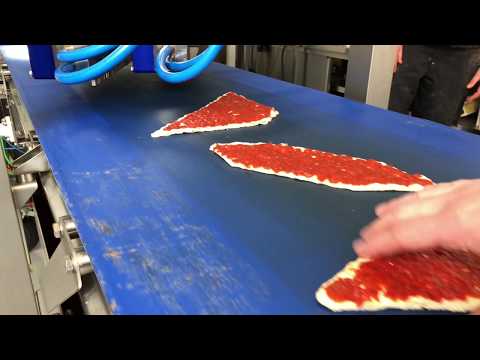
Surface filling is the technique of covering the entire surface of a product with an even layer of a liquid food such as sauce, butter or batter, while keeping a defined sauce-free edge. Vision technology recognises the shape of every product on the conveyor, so the material lands on the product and not around it, even on irregular or randomly placed products. When you change product shapes you upload the matching recipe and keep running, with no mechanical change-overs.

What is on-demand depositing?
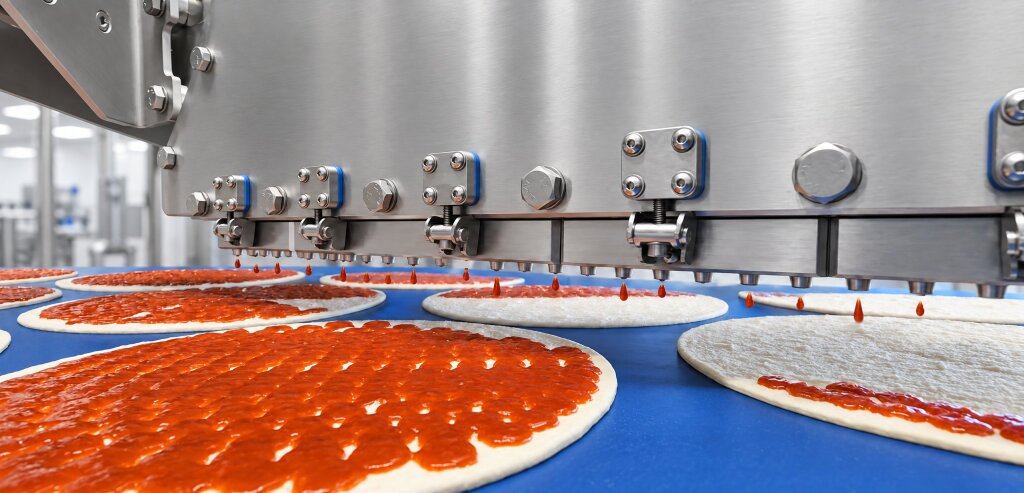
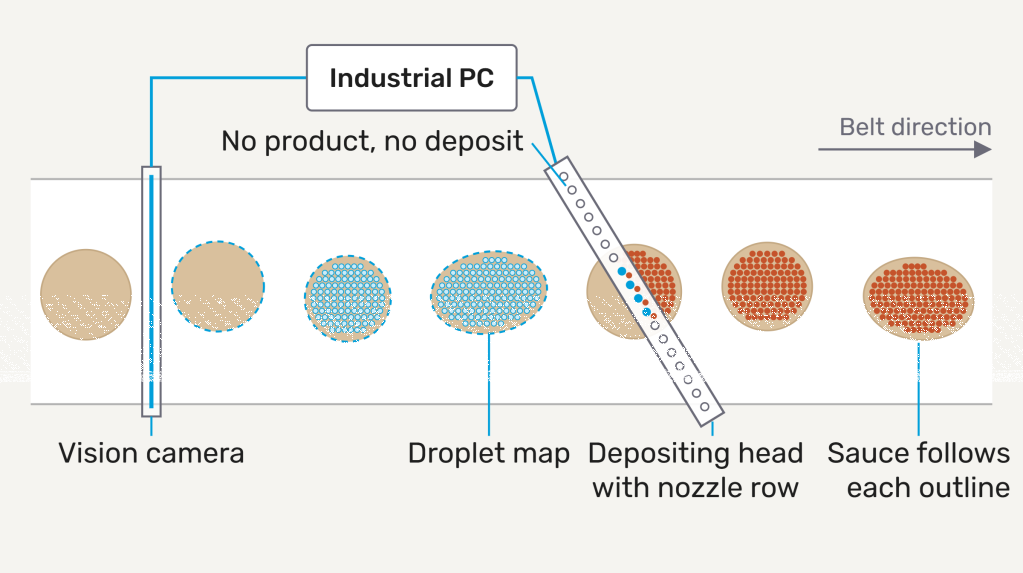
On-demand depositing means each nozzle in the depositing head is controlled individually, so the machine places product exactly where it is needed and only when it is needed. The head is an array of nozzles across the full width of the belt. Vision recognises where every product sits, and each nozzle deposits on its own product, in any pattern, with no fixed tooling and no set product positions. This is the core of how a FoodJet system works, and it is what lets one machine handle many products and patterns without changing parts.
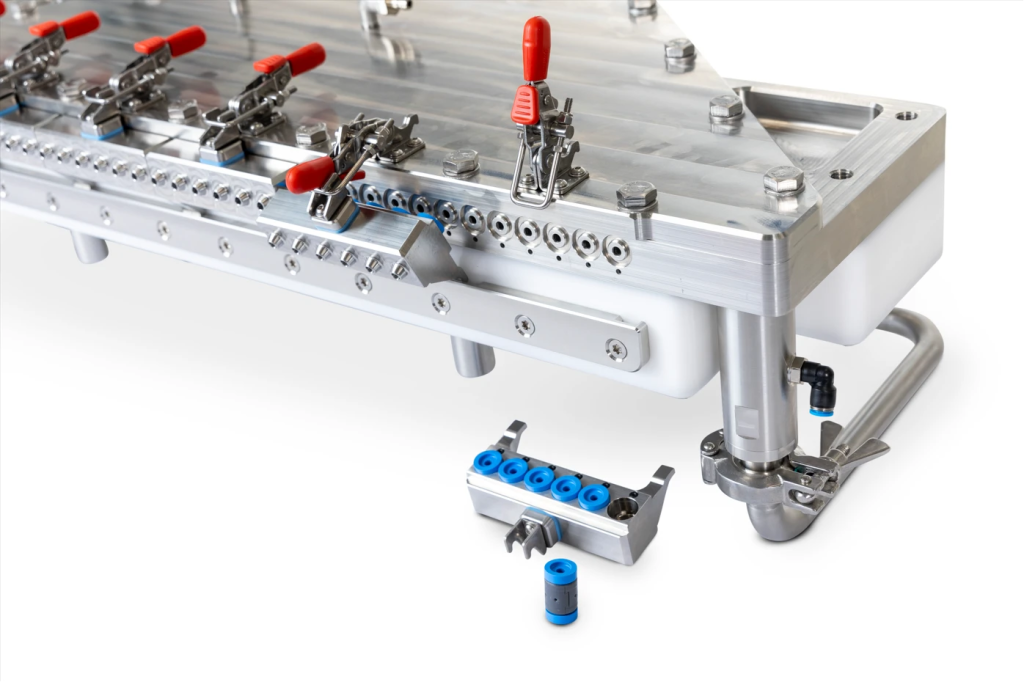
What a nozzle array is

The depositing head is an array of individually controlled nozzles spaced across the full width of the belt. Each nozzle is driven on its own, so the head is not a single fixed tool that stamps one pattern. It is a grid of independent deposit points that can each switch on or off, dose more or less, and follow the product in front of it. Because the nozzles cover the full width, the head works across the whole belt rather than in a few fixed lanes.

How on-demand depositing works

Vision recognises where every product sits on the belt as it passes. The system then tells each nozzle when and how much to deposit, so material lands on each product wherever it happens to be. Products do not need to be lined up or held in a fixed pitch. If a position on the belt has no product, the nozzles above it do not deposit, so there is no product, no deposit, and no waste on the belt. The same head can switch from one pattern or recipe to another in software, without changing tooling.

A clean deposit with pinch valves

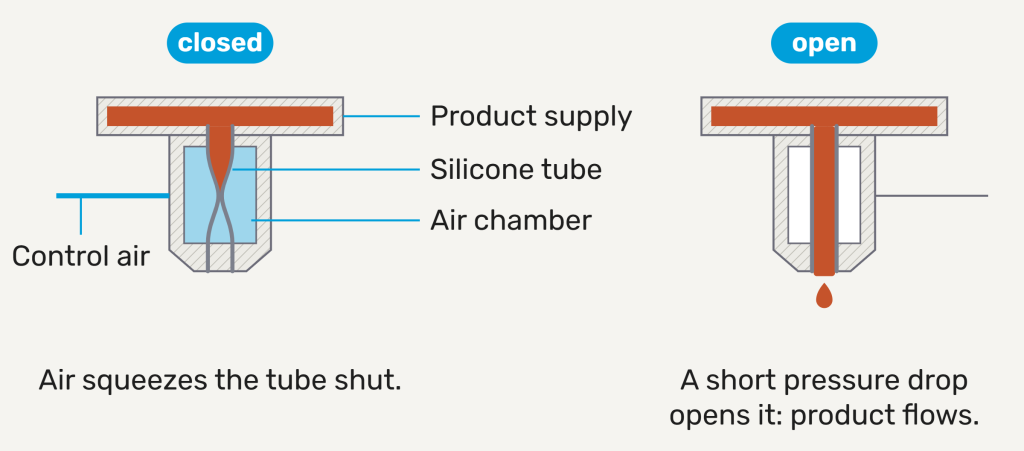
A clean cut-off matters as much as the deposit itself. Pinch valves close the deposit by pinching the product line shut, which stops the flow cleanly without tails, drips or stringing between products. Because the valve pinches a flexible line rather than driving a part through the product, there are fewer contact points to clean and the deposit stays consistent from the first product to the last. A clean cut-off also keeps the belt and the surrounding products free of stray product.

Why it matters

On-demand depositing turns one machine into a flexible line rather than a fixed tool.

  • Any pattern, full width: the head deposits on each product wherever it sits, so you are not tied to fixed lanes or a set pitch.
  • More products per minute: because you do not lose belt space to alignment, you run products closer together and across the full width. The smaller the product, the more this counts.
  • Less waste: vision means no product, no deposit, so material is not lost to the belt between products.
  • Fast changeover: patterns and recipes change in software, not by swapping tooling, so switching products takes less time.
  • Consistent dosing: each nozzle is controlled on its own, so every deposit matches the recipe across the full width.

How we prove it for your product

How a product behaves through the nozzle depends on the material. Viscosity, temperature, particle size and the way a product flows all affect how cleanly and how fast we can deposit it. That is why we do not stop at the principle. For every application we run a trial with your actual product, so you see the deposit, the pattern and the result on your own material before you commit.

What is on-demand depositing?

On-demand depositing means each nozzle in the depositing head is controlled individually, so the machine deposits on each product wherever it sits and only when product is present. It uses vision to find the products and an array of nozzles across the full belt width to deposit on them, in any pattern, without fixed tooling.

What is a nozzle array?

A nozzle array is the depositing head: a row of individually controlled nozzles across the full width of the belt. Each nozzle deposits on its own, so the head can place product anywhere across the belt rather than in a few fixed lanes.

What does no product, no deposit mean?

Vision recognises where products are on the belt. If there is no product at a position, the nozzles above it do not deposit. Material only lands on products, so none is lost to the belt between them.

What is a pinch valve and why does it matter?

A pinch valve closes the deposit by pinching the product line shut, which stops the flow cleanly without tails, drips or stringing. It keeps deposits consistent and the belt free of stray product, and it has fewer contact points to clean.

Do I need different tooling for a different product or pattern?

No. Patterns and recipes change in software rather than by swapping tooling, so the same head handles many products and patterns. We confirm the result for your product in a trial.

Increase accuracy, improve speed and add a unique touch